
Screen-Printing
The vitreous enamel screen-printing process
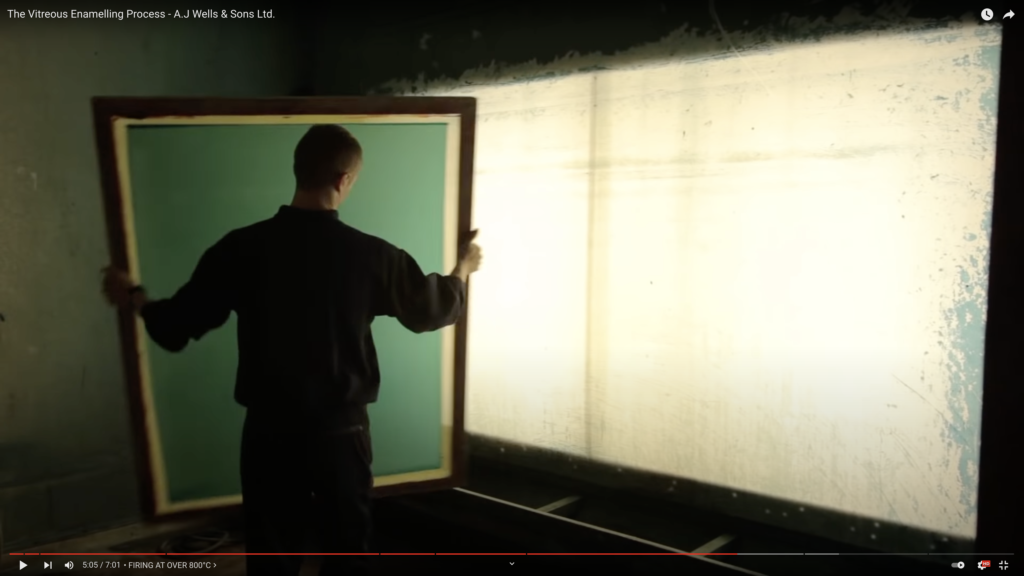
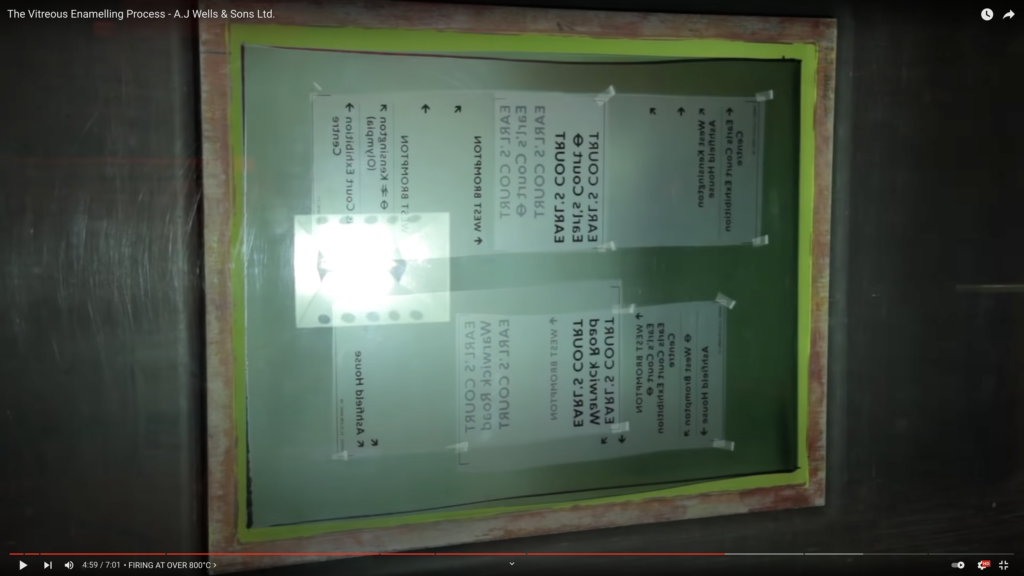
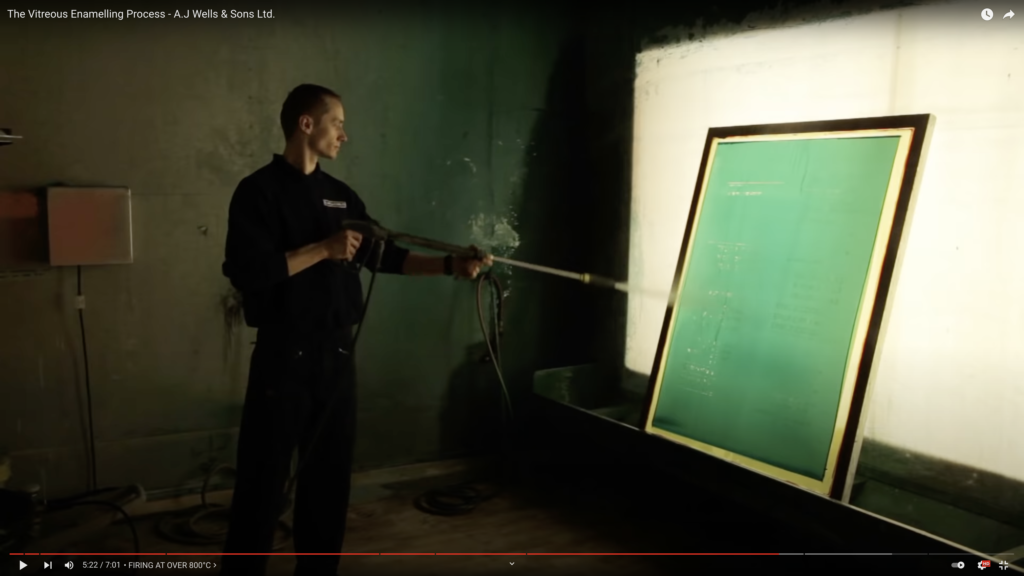
• A mesh screen is stretched over a frame and coated with a light sensitive emulsion.
• Once dry a digital negative can be used to create an exposure of the artwork. The digital negative is placed on the light sensitive surface and then exposed to UV light which renders the image (text) onto the screen.
• This is then jet-washed in water and gaps in the emulsion are left where the negative/image was placed.
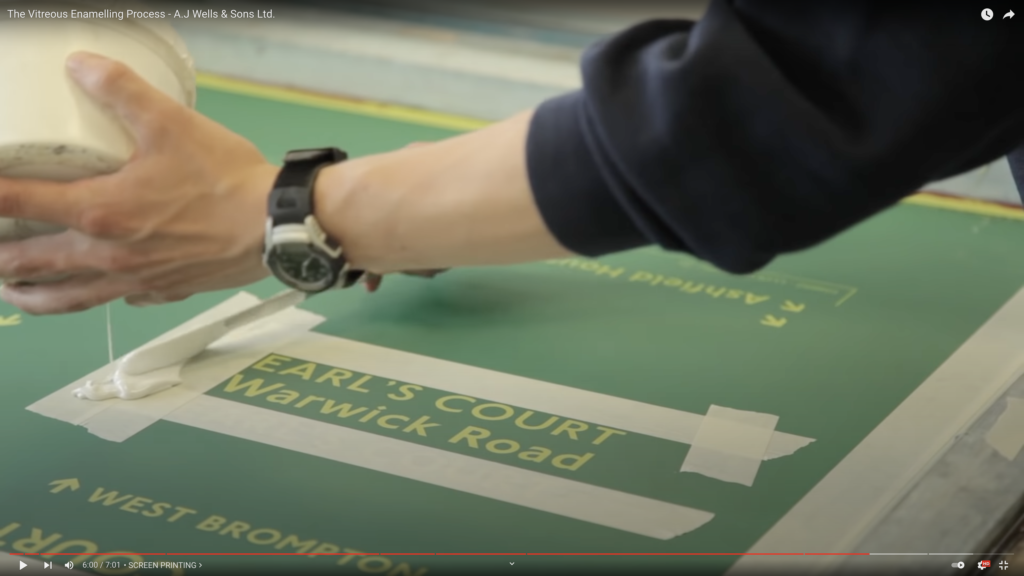


• A squeegy or blade can then be used to pass ink over the gaps in the screen which applies a print onto the substrate’s (vitreous enamel) surface.
• Artwork consisting of multiple colours are built up in layers, having to be processed one after the other.
Our team use a combination of both ink and catalyst to achieve a range of matt, satin and gloss finishes. Adhesion onto a range of substrates is possible including vitreous enamel, metal, plastic, wood and glass. The inks used are environmentally friendly and do not contain ozone-depleting chemicals.
Screen Printing offers the best results when trying to reproduce artwork with solid colours and when there is a requirement to match a specific Pantone or RAL reference.
Screen-printing benefits
- High durability with colouration that never fades
- Solid colours look bold with strong saturation achievable
- We can match specific Pantone/RAL colours
- Our process allows excellent consistency including on repeat orders
- Can be used in combination with enamel-decals to offer a more versatile finish
Limitations
- Not ideal for photographic or highly detailed types of artwork
- A more labour intensive process than enamel-decals as multiple colours need to be individually applied by hand
- In any vitreous enamel printing, silk screen or digital, there is not a true magenta or cyan colour so this makes colour matching a little tricky and unpredictable as certain colours can also change in the firing process. Also, computer screen artwork will always look different to an actual print.
Past Projects Include:



Newcastle Metro – Hilary Paynter
For the 250th anniversary of the birth of the wood engraver Thomas Bewick, Nexus (the public transport authority for The Tyne and Wear Metro) launched ‘The Bewick Commission’ which facilitated the installation of contemporary artwork at its stations.
A.J Wells produced 31 vitreous enamel panels decorated with engravings created by Hilary Paynter. The 2 x 1-metre cladding panels formed a 22-metre long panoramic mural.
Hilary’s intricate engravings were scanned and enlarged to ten times their original size before they were screen-printed onto the enamel panels. The cladding panels were officially unveiled in June 2004.
Happy Street – Yinka Ilori
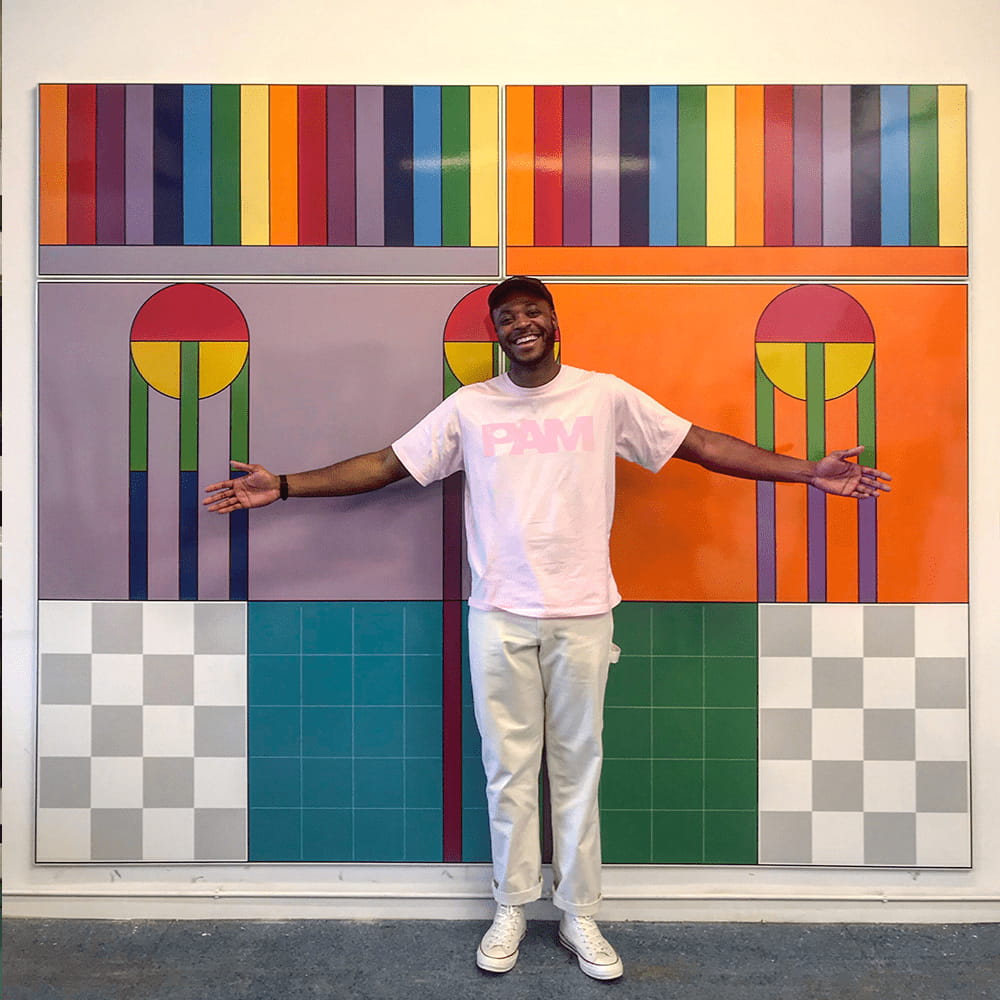
A.J Wells surveyed, manufactured and installed a vitreous enamel cladding panel system for Yinka Ilori’s Happy Street project at Thessaly Road Railway Bridge, Nine Elms, Wandsworth. Vitreous enamel was specified due to its durability and fire rating, in light of it’s location and accessibility to the public. This original large-scale new artwork was commissioned by Wandsworth Council in partnership with the London Festival of Architecture exploring the theme of happiness through the use of colour.
Edgware Road – Jacqui Poncelet
A.J Wells designed, manufactured and installed around 1500 square metres of vitreous enamel artwork cladding at the New Griffith House building and boundary wall at Chapel Street, London, as part of a London Underground Upgrade Package.
Renowned textile artist Jacqui Poncelet provided the design which was screenprinted onto each panel measuring 1.8 x 1.2 metres.
Legibility London
Legibility London is a new pedestrian wayfinding system to help people walk around London.
Based on extensive research, the system uses a range of information, including street signs and printed maps, to help people find their way. It’s also integrated with other transport modes so when people are leaving the Underground, for example, they can quickly identify the route to their destination.
Westminster Mural
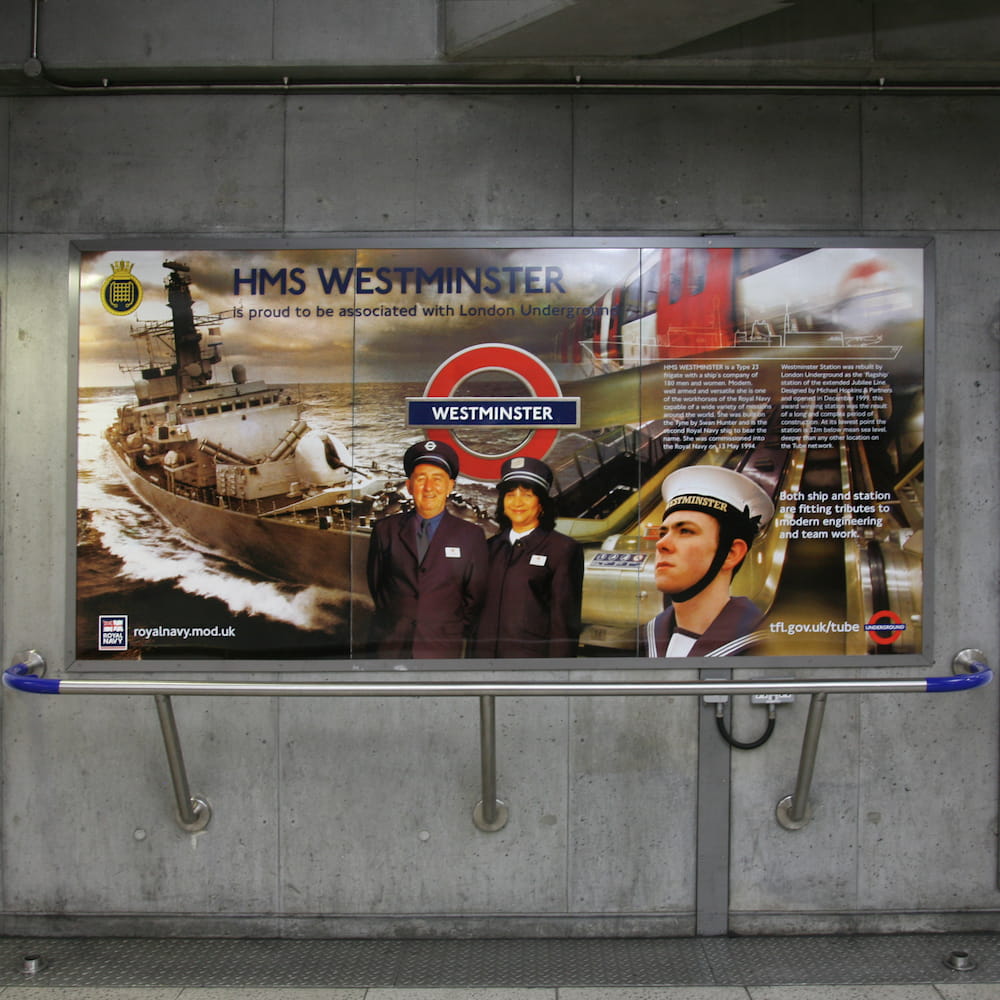
A mural celebrating the partnership between Westminster station and the Royal Navy Frigate HMS Westminster was unveiled at Westminster station on April 27th 2006 by London Underground Chief Operating Officer, Mike Brown, and the ship’s captain, Commander Andrew Betton. The photographic design, measuring 3m by 1.5m, is situated in the central ticket hall of Westminster station, and features two of the station’s staff, Maria Sheikh and Danny Molloy, who have both visited the Type 23 frigate and her crew. It is one of the largest hand printed enamel artworks ever produced.
Contact our team to discuss your project.