
Fabrication
A.J Wells are vitreous enamel specialists and manufacturers of Charnwood Stoves, a leading global stove brand. We design, manufacture and finish all our products at our Isle of Wight factory which is the largest enamel facility in the UK. We have state-of-the-art equipment and boast a high precision metal workshop. Having all our facilities under one roof enables us to manage each project effectively and offer a fast and efficient turnaround.
Fabrication Shop
We have a fully stacked fabrication shop with master craftsmen and technicians using a full array of tools and processes including:
Angle Grinders, Arc Welding, Bandsaws, Bystronic Lasers, Cut-off Saws, Die Grinders, Elevating tables, Impact Drivers, Linishers, Rollers, Iron Worker, Mig Welding, Pillar Drills, Power Press, Rivet Guns, Robot Welder, Stud Welders, Tappers, Vertical and Horizontal Milling Machines, Walk-in Shot Blaster
Automated storage and laser cutting system
The system provides highly accurate and efficient laser cutting with tolerances of just 0.2mm and the capability of cutting material from 0.5mm-25mm in thickness. This gives us the ability to prototype and manufacture designs with great complexity.
With a storage capacity of up to 87 tonnes of both processed and unprocessed sheet material we have an exceptionally high cutting capacity. Automation of such a high volume allows for 24/7 cutting and enables rapid part turnaround.
Fabrication: Vitreous Enamel Panels
- FABRICATION: Panels are formed to the shapes and sizes required to a tolerance of +/-2mm. Flanges will be formed by folding to an outside radius of 3mm. All welds positioned in visible areas are ground to remove surface roughness. The steel conforms to the requirements of BS EN 10209.
- After panel fabrication all metal surface impurities are stripped and cleaned off in a degreaser bath.
- After rinsing and neutralizing an enamel ground coat is applied to the metal. Firing the ground coat at 830 degrees’ Celsius envelopes the metal in glass fusing the two together.
- A cover coat spray is applied
- The decal is immersed in water and the panel has a fine mist of water sprayed on its surface. This helps prevent the decal from tearing whilst applying the decal to the panel. The decal is then slid from its protective backing paper onto the moist panel.
- Any air bubbles are removed using a rubber squeezy or soft damp sponge
- The panel with decal applied is allowed to dry naturally
- VITREOUS ENAMEL: Both sides of a panel are coated with specially selected ground coat enamel frits to ensure good enamel to steel adhesion. The panel face side is further coated with enamel cover coat using frits selected for good surface appearance and gloss properties.
- All enamelling is in accordance with BS 3830
- The panel with image is now fired again at 830 degrees for approximately 4 hours, encapsulating the image within the glaze to give the finished article.
- Panels are allowed to dry naturally before being packed in sequence to suit mural graph layout
Case Studies
A.J Wells benefits from an experienced in-house design team, skilled craftsmen and technicians that have worked on a wide range of unique and challenging projects spanning 50 years of business. This wealth of experience coupled with state-of-the-art laser profiling and a high precision metal workshop gives us the capacity to also take on a wide range of bespoke projects.




Walter Jack
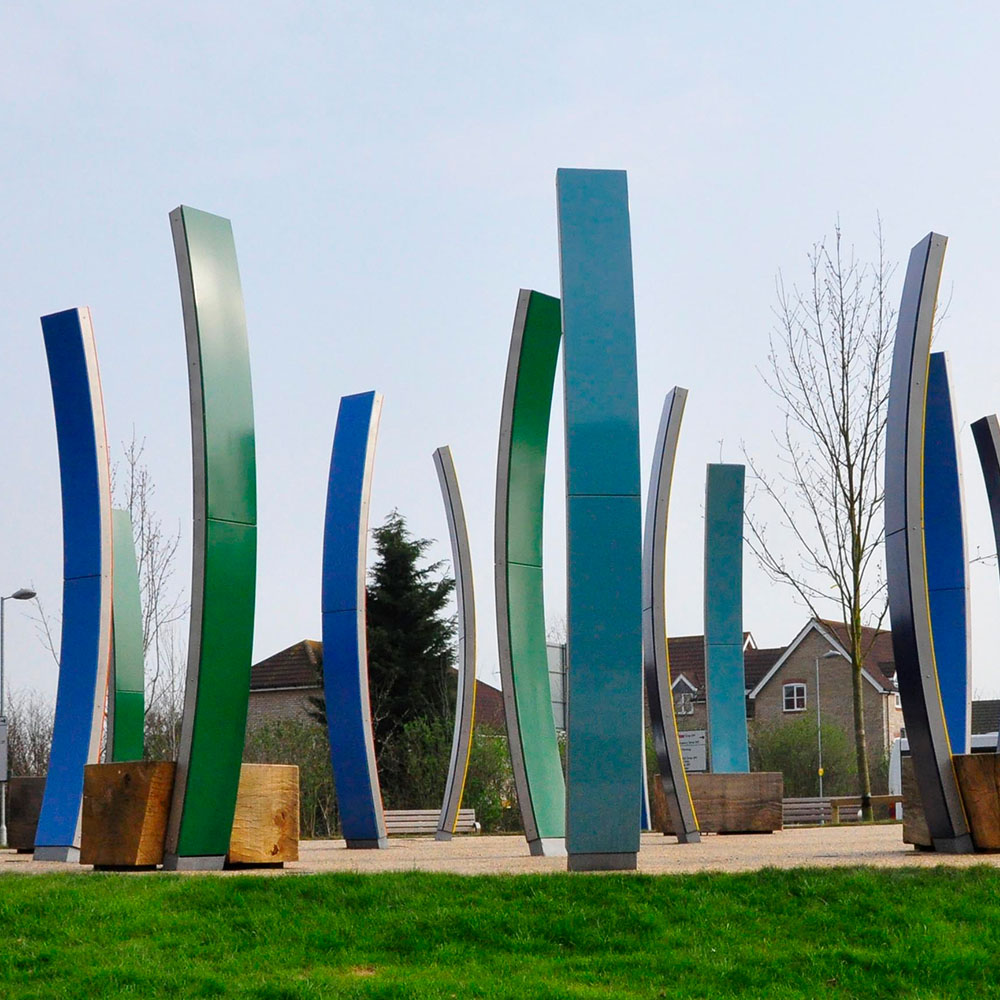
Walter Jack designed a series of 40 curved monoliths each one a different colour. A.J Wells supplied the steel material to Walter Jack who had then fabricated it to fit the structural element of the monoliths and then returned them to A.J Wells to be enamelled.
Edgware Road
We collaborated with renowned textile artist Jacqui Poncelet whose design was screen-printed onto 1500 square metres of vitreous enamel panelling with each panel measuring 1.8 x 1.2 metres. A.J Wells designed, manufactured and installed the 1500 square metres of vitreous enamel artwork cladding at the New Griffith House building and boundary wall at Chapel Street, London, as part of a London Underground Upgrade Package.
Crossrail
A.J Wells has designed, developed, manufactured and installed thousands of signs ranging from door plates and totems, to illuminated fascias and roundels for many of the new Crossrail, Elizabeth Line stations. Above you can see a video showcasing some of the metal parts fabricated during this process.
Canary Wharf
As part of the preparatory works for Crossrail, Canary Wharf, A.J Wells & Sons were commissioned to produce 500m2 of vibrant yellow vitreous enamel cladding across four levels of the sub-terrain station – including the lift shaft section.
Newcastle Metro
A.J Wells produced 31 vitreous enamel panels decorated with engravings created by Hilary Paynter for the Newcastle Metro. The 2 x 1 metre cladding panels formed a 22 metre long panoramic mural.
Chelsea Flower Show
In 2004 A.J Wells was approached by Diarmuid Gavin Designs to help create an epic garden at the Chelsea Flower Show. The garden featured over 5,000 individually coloured enameled balls to create a habitable pod within the garden. Over an intense time frame of just 4 weeks, A.J Wells were followed closely by a film crew as they enameled the balls. Due to the spherical nature of the balls bespoke spraying and firing jigs were built to enable each ball to be seamlessly enameled.
A range of specialist contrasting colours were developed in-house in conjunction with Diarmuid Gavin and renowned fashion designer Orla Kiely.
Basildon
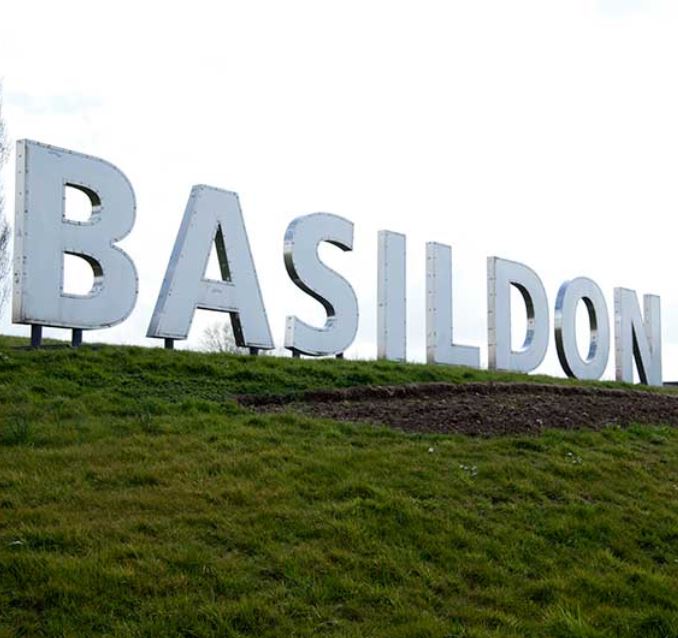
A.J Wells were tasked with the manufacture of eight enormous, 1600mm high, vitreous enamel letters that formed the front face of this incredible sign installation. The letters were quite an engineering achievement due to their large scale. Each letter was initially laser cut from two full-size sheets of steel that were then seamlessly, edge to edge, hand-welded to form one incredibly large sign face.